
THANK YOU FOR SUBSCRIBING
× 
Prop Tech Outlook Weekly Brief
Be first to read the latest tech news, Industry Leader's Insights, and CIO interviews of medium and large enterprises exclusively from Prop Tech Outlook


 Greg Ericksen, Chairman and CEO
For over five decades, Jackson Control has ensured that all these systems operate in harmony, enhancing building performance and long-term value.
But as technologies evolve and the world grapples with aging infrastructure, rising energy costs, pressure to meet sustainability goals and an AI-driven future on the horizon, a new challenge emerges: how to make existing buildings smarter, more secure and future-ready?
For Jackson Control, the answer lies in retrofitting. For decades, this technology construction management company has been transforming legacy buildings into high-performing, future-ready environments. As a leading provider and distributor of building technology solutions, Jackson Control drives this transformation through smart building integration, uniting the three pillars of modern performance: efficiency, security, and health.
This retrofit-first strategy delivers tangible business value by cutting costs, boosting energy efficiency, enhancing occupant health, while supporting ESG goals and strengthening cyber security.
“For us, retrofitting isn’t just a workaround; it's a strategic imperative,” says Greg Ericksen, chairman and CEO. “There’s a massive opportunity in taking care of what’s already built and we’re making the existing stronger, smarter and more secure."
Transforming Infrastructure for Long-Term Value
 As the world chases the next big thing, Jackson Control offers a different narrative, one rooted in legacy, pragmatism and transformation. Backed by five and a half decades of hands-on application experience, the company brings a rare depth of understanding to the table. Its expertise lies in navigating and integrating complex legacy systems with precision, unlocking value by preserving existing equipment and prior investments.
While new builds do bring innovation and growth, they account for only one to two percent of the global building stock each year. Jackson Control directs its expertise toward the vast opportunity within the existing 98 percent—buildings already in operation—opening door to their untapped potential for transformation and lasting impact. According to Ericksen, “over the lifecycle of a typical facility, retrofit investments end up being about 3.5 times greater than the initial cost of new construction.”
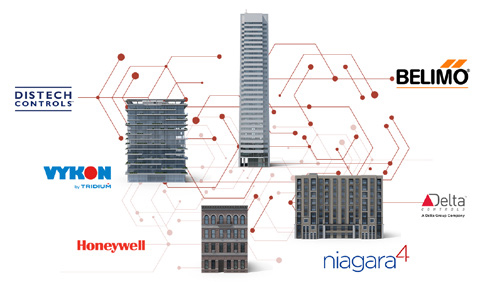
The company’s retrofit-first model is designed to be brand-agnostic and preserve existing infrastructure. Instead of relying on a “rip and replace” approach, Jackson Control helps clients retain and optimize their existing systems, delivering up to 50 percent cost savings while minimizing disruption. Central to this strategy is avoiding vendor lock, as proprietary systems limit service options and inflate costs. Its solutions prioritize integration over replacement, offering smarter, more sustainable outcomes tailored to the client’s needs.
Retrofit opens the door, but Jackson Control stays for the full lifecycle. The company serves as an outsourced control department, guiding clients through every stage of the building lifecycle from planning and budgeting to installation and ongoing support. Jackson Control’s team provides strategic five to ten-year roadmaps, coordinates with contractors, oversees commissioning and offers post-installation training. It's this consistency and commitment that have earned the company a reputation as a trusted long-term partner.

“We view the accounts that we work with as long-term clients, not just one-time customers,” says Ericksen. “And because of that, we have a fiduciary responsibility to make sure they’re always getting the best available option in the market.”
The company’s approach is particularly valuable for large portfolios, such as hospitals, universities or real estate investment trusts (REITs), where managing technology upgrades across multiple properties can be daunting without expert guidance. It uses decades of application know how, paired with open protocols, and advanced integration tools to connect siloed building systems, ensuring seamless, centralized management.
Smart systems reduce reliance on manual oversight, enabling leaner operational teams to accomplish more with fewer resources. In a labor-constrained environment, where engineering support is scarce, Jackson Control equips facility managers with automated systems, intuitive dashboards, and smart tools that reduce dependence on manual oversight.
We view the accounts that we work with as long-term clients, not just one-time customers. And because of that, we have a fiduciary responsibility to make sure they’re always getting the best available option in the market
The Three Pillars of Smart Performance
Moreover, optimization algorithms embedded within the systems allow for automated actions, like load shedding, demand response and predictive maintenance that help buildings operate at peak efficiency. This proactive energy management reduces the environmental footprint of facilities while helping clients prepare for what many industry leaders consider inevitable: rising utility costs.
At the core of this approach is a unifying framework: the three pillars. Efficiency, security and health serve as the guiding principles for Jackson Control’s solutions and services. In building efficiency, it focuses on optimizing and providing visibility across HVAC, lighting, plug load, and water systems, helping organizations track KPIs related to carbon emissions, energy consumption, and air quality. These tools support global frameworks like LEED, WELL and GRESB, providing clients with exportable reports and historical data to substantiate performance claims.
-
For us, retrofitting isn't just a workaround; It’s a strategic imperative. There's a massive opportunity in taking care of what's already built and we're making the existing stronger, smarter and more secure
Moreover, optimization algorithms embedded within the systems allow for automated actions, like load shedding, demand response and predictive maintenance that help buildings operate at peak efficiency. This proactive energy management reduces the environmental footprint of facilities while helping clients prepare for what many industry leaders consider inevitable: rising utility costs.
 On the security front, the company handles access control, surveillance and even cyber security. As building systems become increasingly interconnected, they also become more vulnerable to cyber threats. The company implements zero trust architecture, where all users, devices and systems must be continually verified and ensures proper segmentation between IT and OT environments. Using VPNs and encrypted protocols, Jackson Control isolates critical infrastructure from lateral attacks. Regular patch management and collaboration with secure-first vendors are standard practices and cyber risk assessments are routinely conducted as part of system lifecycle management.
This level of diligence is particularly important in environments like healthcare, education or government buildings, the sectors that face heightened risks due to the sensitive data they handle and the essential nature of their operations.
Health, the third pillar, encompasses indoor air and water quality, leak detection and remediation, and other environmental controls. These features are increasingly critical for occupant well-being and for regulatory compliance and building certifications.
These three pillars work in sync, each reinforcing the other. Together, they form the foundation for Jackson Control’s holistic approach to building performance, prioritizing long-term impact over short-term fixes.
From Air Conditioning to AI
With a strong foundation in place, Jackson Control helps clients take the next step: building AI-ready systems that are smarter, faster and built for long-term adaptability. This forward-thinking philosophy is rooted in a long legacy of adaptation and innovation. Jackson Control was established during the advent of air-conditioning. It began with supporting contractors in need of technical expertise to ensure seamless installations. But as building technologies diversified and evolved, so did Jackson Control, gaining a unique vantage point: the ability to understand, integrate and innovate across generations of building systems.
Now, with AI and ML revolutionizing facility management, Jackson Control is helping clients build the foundation for what it calls an ‘information utility.’ Just like water or electricity, buildings today require a consistent flow of usable data to be effectively managed.
Creating this utility means every device must be connected, tuned and maintained. To unify operations, Jackson Control standardizes on the Tridium Niagara platform—an open automation system that integrates HVAC, lighting, security and energy into a single cohesive ecosystem.
The company is already deploying smart edge devices that allow AI models to process data locally, improving response times and reducing reliance on the cloud. These systems enable predictive maintenance, automated anomaly detection and real-time optimization. And because the data is clean, consistent and accessible, AI applications can be scaled incrementally based on a client’s level of readiness.
This is what Ericksen refers to as “building AI done right,” designing systems that are intelligent, measurable, configurable and built to last.
Culture that Builds Competence
As the industry faces mounting pressures from rising utility rates and tightening ESG mandates, Jackson Control stands at the crossroads of urgency and opportunity. With energy costs surging due to the rise of AI, data centers, and utilities announcing rate hikes of up to 48 percent, the need for smarter, self-optimizing buildings has never been more critical.
Yet the economics of retrofitting have never been better, with wireless tech, PoE and intelligent automation reducing installation costs and shortening payback periods. A well-maintained legacy system, Jackson Control notes, can often outperform a new one if it’s tuned and understood.
Internally, Jackson Control nurtures a culture of technical competence, where engineers engage in hands-on, immersive training, referred to as the “firehose effect.” This ensures every recommendation stems from field-proven experience. With nearly 4,000 buildings in its portfolio, Jackson Control pairs scale with personal, long-term client relationships.
Looking forward, the company is helping clients move from reactive fixes to predictive operations. It’s building AI-ready platforms, enabling sensor-rich digital twins, and creating converged cyber-physical security frameworks.
As the American businessman and philanthropist Bill Gates recently observed, the AI era is ushering in a new wave of expertise, with AI engineers, energy specialists, and biologists expected to lead the way. Jackson Control already commands two of those three strengths, positioning the company squarely at the forefront of what comes next.
The company’s ability to bridge generations of building systems while embracing new technologies like AI and edge computing makes it uniquely equipped to help clients navigate today’s challenges and tomorrow’s opportunities. Jackson Control makes buildings smart today and for tomorrow—engineered to adapt, evolve and excel for decades to come.

Company
Jackson Control
Management
Greg Ericksen, Chairman and CEO
Description
Jackson Control is a technology construction management company specializing in retrofitting and smart building integration. With a focus on efficiency, security, and health, it transforms legacy infrastructure into AI-ready, high-performing environments—empowering clients to optimize operations, reduce costs, and meet evolving regulatory and sustainability demands.

